Automatic Gate Systems
Sliding and swing gate automation — survey, installation, safety testing and maintenance, all handled by our own team.
Comfortable, controlled access with sliding and swing gate systems. We measure your gate on site, calculate the load, select the right operator and hand it over only after the safety tests pass.
What Is an Automatic Gate System?
An automatic gate system turns a gate leaf into a single controlled access point by combining an operator, a control board and safety sensors. It removes the need for a driver to leave the vehicle, for staff to push the gate by hand, and for anyone to discover the gate left open overnight.
Installed correctly, it delivers three things at once: convenient access, entrance security and a measurable record of who passed through. Selecting an automatic gate motor is not only about gate weight — daily cycle count, leaf width, wind load, ground slope and the condition of the track all feed into the calculation. An undersized operator runs fine for the first few months, then shows up as gearbox and control board failures. That is why every project starts with a site survey and a load calculation.
What We Offer
- Sliding (track-mounted) automatic gate operators
- Swing gate operators for garden and facility entrances
- Photocells, flashing warning lights and safety edge protection
- Remote control, card access and mobile app integration
- Manual release and battery-backed operation during power cuts
- Scheduled maintenance and spare part supply
Gate Types We Install
Every gate type has its own operator class, safety package and maintenance routine. The figures below are typical application ranges; the exact specification is set after the site survey.
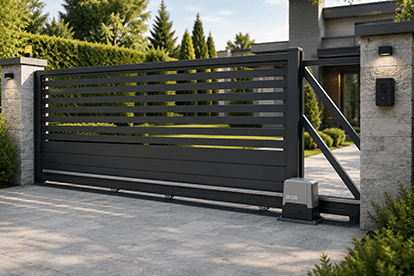
Sliding (track-mounted) gates
The gate travels sideways, making the most efficient use of the space in front of the entrance. It is the standard for residential complexes and factories. Gear rack alignment, the catch bracket and track flatness directly determine performance.
- Gate weight300 – 2000 kg
- Speed~10 – 20 m/min
- Supply230 V AC / 24 V DC
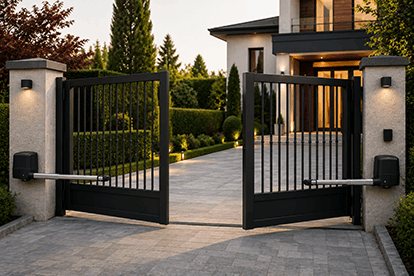
Swing (hinged) gate operators
Preferred for villa gardens and facility entrances. Ram operators suit narrow pillars, while articulated arm operators perform better where there is more clearance. On double-leaf gates a delayed closing sequence is essential.
- Leaf width1.8 – 5 m
- Leaf weight200 – 800 kg
- TypeRam / articulated arm
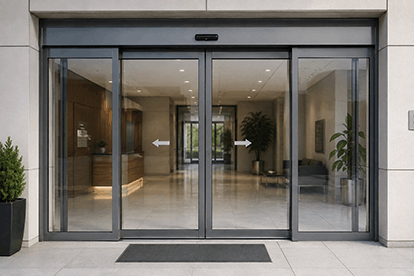
Automatic pedestrian doors
Sliding glass automatic doors for hotel, office and retail entrances. Motion radar and safety photocells work together, and a fail-safe opening mode is configured for fire scenarios.
- LeavesSingle / bi-parting
- DetectionRadar + photocell
- ModesSummer / winter / lock
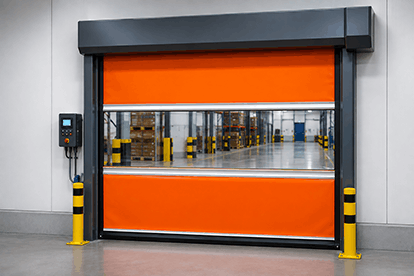
High-speed PVC doors
For internal openings in cold storage, food and logistics facilities. The high opening speed cuts heat loss and dust transfer while keeping up with forklift traffic.
- Opening speed~1 – 2.5 m/s
- CurtainPVC with vision strip
- DutyVery heavy
What an Automatic Gate Is Made Of
These are the line items to check when you compare quotations. Cheaper-looking offers usually leave out the photocells, the safety edge or the battery backup.
Operator and gearbox
The unit that moves the gate. 230 V AC types are economical; 24 V DC types are better for battery backup and intensive use.
Control board
The brain that manages opening logic, auto-close timing, force and torque settings. Getting these settings right is half of the safety work.
Photocells (safety beams)
Stop the movement and reverse it when a person or vehicle is detected in the opening. They are positioned at more than one height.
Safety edge
A pressure-sensitive strip along the leading edge. It stops the system on contact and forms the second layer of crushing protection.
Warning light and signals
Gives a visual warning while the gate is moving. On busy vehicle entrances it is paired with a traffic light column.
Transmitters and receiver
Rolling code remotes are protected against cloning. A lost remote can be deleted from memory individually.
Card access and intercom
Proximity cards, keypads, video intercoms and plate recognition can all be integrated into the gate automation.
Mobile app module
Open the gate from a phone, authorise users and review access logs. For site management it ends the remote-control distribution problem.
Battery backup
Keeps the gate running for a number of cycles during a power cut. Without it, the manual release lever takes over.
Track, rack and rollers
On sliding gates most faults come from a distorted track and worn rollers rather than the operator itself. Ground flatness is critical.
Supply and earthing
A dedicated circuit, correctly sized cable and proper earthing directly affect control board life. A surge arrester is recommended where lightning is a risk.
Manual release
A key-operated release lets the gate be opened by hand during a fault or power loss. We always demonstrate it at handover.
Which Operator for Which Gate? — Selection Guide
The table below is a starting point. The final operator class is determined by measuring gate weight, wind load, ground slope and daily cycle count.
| Application | Gate type | Load range | Recommended drive | Traffic level |
|---|---|---|---|---|
| Villa / detached house | Swing garden gate | 200–300 kg per leaf | 24 V DC ram operator | Low (10–30 cycles/day) |
| Apartment / small complex | Sliding gate | 400–600 kg | 230 V AC sliding operator | Medium (50–150 cycles/day) |
| Large complex / residence | Sliding gate + pedestrian gate | 800–1200 kg | 24 V DC with battery backup | Heavy (150–400 cycles/day) |
| Factory / warehouse yard | Heavy sliding gate | 1200–2000 kg | Heavy-duty industrial operator | Heavy, multi-shift |
| Car park entrance | Boom barrier | 3–6 m boom | Fast-cycle barrier operator | Very heavy (continuous) |
| Hotel / office building | Automatic glass door | 80–150 kg per leaf | Sliding pedestrian door operator | Very heavy (continuous) |
| School / institutional campus | Sliding gate + turnstiles | 600–1000 kg | 24 V DC with card access | Peak-hour heavy |
From Survey to Handover
-
Free site survey and measurement
We come to the site and measure the opening width, leaf weight, track condition, ground slope, electrical infrastructure and daily cycle count. If there is an existing gate, we also report whether it is suitable for automation.
-
Specification and quotation
Based on the measurements we set the operator class, the safety package and the access method. Every item is listed separately in the quotation, so nothing appears as a surprise later.
-
Infrastructure preparation
Operator foundation, cable ducting, a dedicated fused supply line and earthing are completed. Skipping this step is the most common reason a system fails in its first winter.
-
Mechanical and electrical installation
The operator, gear rack, catch bracket and limit switches are fitted, followed by the control board, photocells, warning light and access devices.
-
Adjustment and safety testing
Force, torque and auto-close timing are set. We run photocell interruption tests, safety edge response tests and a manual release trial, and record the results on the handover form.
-
Handover, training and maintenance plan
We walk the user through manual opening, remote programming and first response during a fault. The warranty document, user manual and maintenance schedule are handed over.
Safety and Standards
A powered gate is treated as machinery under the applicable regulations. Protection against crushing, shearing and trapping is not an optional extra — it is part of the installation. We run the safety tests at every handover and leave the results in writing.
Product standard
Defines the essential performance and safety requirements for industrial, commercial and garage doors and gates.
Safety in use
Covers force limitation, detection and protection methods for the safe use of power-operated doors and gates.
Test methods
Sets out how closing forces are measured and how safety devices are verified.
Mechanical aspects
Covers mechanical strength, balancing of the leaf and measures against derailment.
The four gaps we see most often in the field
Photocells fitted at a single height, no safety edge at all, force settings left at factory defaults, and a manual release the user has never been shown. These are the first four things we check on every site we take over.
Who Is It For?
- Residential complexes and housing estatesMobile authorisation instead of remotes, intercom integration for visitor access.
- Factories and warehouse yardsHeavy sliding gates, multi-shift duty, safety devices suited to forklift traffic.
- Villas and detached homesSwing operators, battery backup, access without leaving the vehicle.
- Hotels and office buildingsAutomatic glass doors, fail-safe opening for fire scenarios, seasonal operating modes.
- Schools and institutional campusesCard access, access records, automatic scenarios tied to arrival and departure times.
- Car parks and shopping centresPlate-recognition barriers, high-cycle operators, compatibility with payment systems.
What Scheduled Maintenance Covers
For homes and villas once or twice a year is enough. For complexes, factories and car parks running hundreds of cycles a day we recommend every three to six months. Maintenance catches the worn roller or the drifting photocell before it becomes a breakdown, which lowers total cost.
- Mechanical inspectionTrack cleaning, roller and gear rack wear, leaf balance, bolt torques.
- Safety verificationPhotocell alignment, safety edge response, closing force measurement.
- Electrical and firmwareBoard parameters, transmitter memory, battery health, terminal connections.
- ReportingWork carried out and anticipated spare part needs are left in writing.
More on our technical service and maintenance
Our Service Area: 11 Provinces, 158 Districts
Because we work with our own field team, we respond to breakdown calls without waiting on subcontractors. Within İstanbul we aim for same-day response; in the other provinces we work by scheduled appointment.
- İstanbul
- Kocaeli
- Bursa
- Sakarya
- Tekirdağ
- Balıkesir
- Çanakkale
- Edirne
- Kırklareli
- Yalova
- Bilecik
Why Cortek?
We run the whole process in house — survey, installation, testing and maintenance. The operators and control systems we use come with a warranty, and we provide 24/7 technical support after installation. We can reach sites quickly across the entire Marmara Region: 11 provinces and 158 districts.
No subcontractors
From survey to installation, testing to maintenance, it is our own team. When something fails, responsibility sits in one place.
Operator and board warranty
The operators and control systems we install are covered by warranty; the scope is shared in writing at the quotation stage.
24/7 technical support
If you are stuck at the gate, we guide first response over the phone and then schedule the field team.
Spare parts in stock
We keep frequently replaced items — photocells, boards, rollers, transmitters — on the shelf, which shortens waiting time.
Proven on site
You can review completed installations at residential, school, industrial and retail entrances in our references.
Transparent quotation
Operator, safety devices, infrastructure and labour are itemised separately. You see exactly what you are paying for.
Frequently Asked Questions
Can you automate my existing steel gate?
In most cases, yes. The leaf needs to be sound, balanced and sitting properly on its track. During the survey we check leaf weight, track flatness and hinge condition. If the gate is distorted or the track is damaged, we recommend mechanical repair first — an operator fitted over faulty mechanics fails quickly.
Should I choose a sliding or a swing gate?
The deciding factor is the space in front of the gate. If there is not enough clearance in the swing direction, or vehicles park close to the entrance, a sliding gate is the better answer. If there is no wall run for the gate to slide along, a swing system is used instead. On sloping ground swing gates can be problematic, so we usually recommend sliding.
Will the gate open during a power cut?
Yes. There are two routes: with battery backup, the gate keeps completing a number of open-close cycles during the outage. Without a battery, the key-operated manual release fitted to every operator is used and the gate is moved by hand. We have the user perform this themselves at handover.
What determines the price of an automatic gate?
Five items drive the price: the operator class required by gate weight, the extent of the safety package (number of photocells, safety edge, signalling), the access method (remote, card, plate recognition, mobile), infrastructure work (foundation, cabling, track repair) and installation labour. The gap between two quotations for the same gate usually comes from the safety package.
How long does installation take?
On a typical residential or villa gate with the infrastructure already in place, installation and adjustment finish in one day. If a foundation has to be poured, ducting opened or the track renewed, it can extend to two or three days. Concrete curing time means some jobs are scheduled across two separate visits.
Are photocells mandatory?
Treat them as mandatory for safety. Photocells stop the movement and reverse it when a person or vehicle is detected in the opening. At entrances where children are present, a single beam height is not enough; we recommend beams at multiple heights combined with a safety edge.
Can remote controls be cloned?
Remotes using rolling code technology change their code on every press, so they cannot be duplicated with simple cloning devices. Older fixed-code systems do carry a risk; we upgrade those by replacing the receiver. A lost remote can also be deleted from memory individually.
Can I open the gate from my phone?
Yes. A GSM or Wi-Fi module added to the control board lets the gate be opened from a mobile app. For site management the real benefit is central control: user authorisation is managed in one place, a departing resident's access is revoked instantly, and access logs can be reviewed. Handing out and collecting remotes stops being a problem.
How often should maintenance be done?
Once or twice a year is enough for homes and villas. For complexes, factories and car parks running hundreds of cycles a day, we recommend every three to six months. Maintenance catches a worn roller or a misaligned photocell before it becomes a breakdown, which lowers total cost.
The gate stops or reverses while opening — what causes that?
The most common causes are a dirty or misaligned photocell lens, stones or ice on the track, increased friction from worn rollers, a force setting left too low on the board, and a weak battery. Most of these are resolved within maintenance; we can also walk you through the first checks over the phone.
How quickly do you respond to a breakdown?
Within İstanbul we aim to attend calls the same day. In the other Marmara provinces we respond by scheduled appointment. Customers with a maintenance contract are prioritised in the call queue.
What does the warranty cover?
The operators and control systems we install carry a product warranty; during the warranty period we cover parts and labour for manufacturing faults. Damage from external causes — vehicle impact, lightning, flooding, unauthorised intervention — falls outside the warranty. We share the exact scope in writing at the quotation stage.
Let us measure your gate and choose the right system together
Send us your address and gate type, and our team will visit for a survey and prepare an itemised quotation. Both the survey and the quotation are free.