Barrier Systems
Controlled vehicle access for car parks and facilities — fast-opening boom barriers built for heavy daily traffic.
We install fast, durable barrier systems for car parks, residential entrances, factories and fuel stations. The operator class is chosen to match your traffic volume, and the system is handed over already integrated with licence plate recognition or card access.
What Is a Barrier System?
A barrier system consists of a motorised housing, a spring-balanced boom and vehicle detection hardware, controlling vehicle access at a single point. What separates it from a gate is frequency: a residential gate might run 200 cycles a day, while a shopping centre car park barrier can exceed 2,000.
That is why the deciding factor when choosing an automatic boom barrier is not boom length but cycle capacity. A light-duty operator will lift a 4-metre boom without trouble; in a busy car park, though, the gearbox and balance spring will fatigue within months. During the survey we establish daily vehicle count, peak-hour load and how access will actually be managed — card, plate, ticket or intercom.
What We Offer
- Fast-opening barrier booms for heavy traffic
- Integration with card access and licence plate recognition systems
- LED-lit, impact-resistant boom design
- Traffic signalling and inductive loop vehicle detection
- Industrial operator options for intensive use
Barrier Types
Boom type is chosen according to lane width, ceiling height and whether pedestrians also need to be stopped. The figures below are typical application ranges.
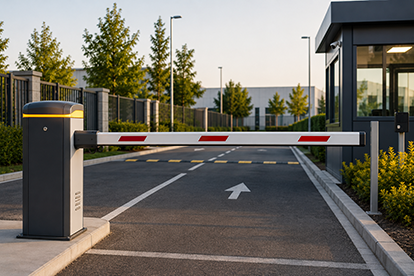
Straight boom barrier
The standard solution. Round or oval aluminium boom, with LED strip options for high visibility at night. This is the type used at most residential, industrial and car park entrances.
- Boom length3 – 6 m
- Opening time3 – 6 s
- DutyMedium / heavy
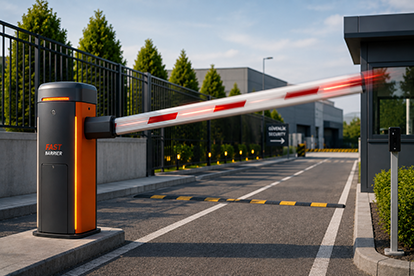
High-speed barrier
For shopping centres, universities and large car parks where queues build at peak hours. A short opening time and an operator rated for continuous duty cut waiting time noticeably per vehicle.
- Boom length3 – 4 m
- Opening time0.9 – 1.5 s
- DutyVery heavy / continuous
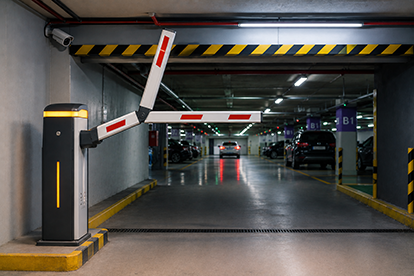
Articulated (folding) boom
Used in covered car parks where the ceiling does not allow the boom to rise fully upright. The boom folds at the midpoint as it lifts, so full lane width is preserved even under a low soffit.
- Boom length2.5 – 4 m
- Headroom needed~1.5 – 2 m
- UseCovered car parks
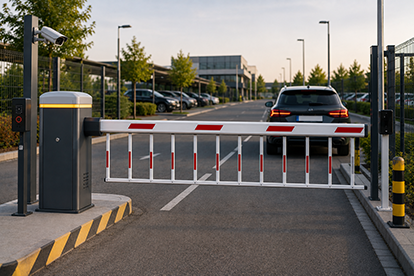
Skirted (fenced) boom
A fence panel under the boom stops pedestrians as well as vehicles. Preferred at industrial sites and campus entrances where uncontrolled foot traffic is a problem.
- Boom length3 – 5 m
- ExtraPedestrian blocking
- NoteHigher wind load
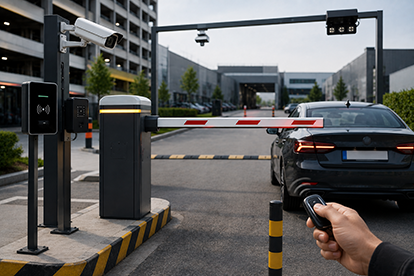
Plate recognition car park set
Barrier, plate recognition camera and software installed as one package. Registered vehicles pass without stopping, visitors are logged. See our licence plate recognition page for details.
- RecognitionCamera + software
- RecordsEntry/exit log
- ExtraResident/visitor split
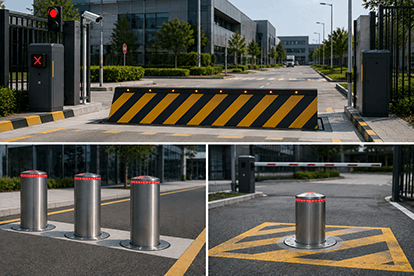
Road blockers and bollards
Hydraulic obstacles for high-security institutional and facility entrances, where a boom barrier cannot physically stop a vehicle. Usually installed alongside a boom barrier as a second layer.
- DriveHydraulic
- ApplicationHigh security
- InstallationRecessed into ground
What a Barrier System Is Made Of
These are the line items to check when you compare quotations. Cheaper-looking offers usually leave out the loop detector, the photocells or the uninterruptible power supply.
Operator and gearbox
The item that sets cycle capacity. Busy car parks need an industrial operator rated for continuous duty.
Balance spring
Counterbalances the boom so the operator does not carry its full weight. The wrong spring for the boom length overloads the motor and shortens its life.
Control board
Manages opening logic, auto-close timing, deceleration ramps and connections to external systems.
Inductive loop detector
A wire loop laid into a slot cut in the road surface detects vehicles. It prevents the boom closing while a vehicle is underneath, and triggers closing once the vehicle has cleared.
Photocells
A second detection layer on top of the loop. They matter most for motorcycles and pedestrians, which a loop detects poorly.
Traffic signalling
Red/green traffic lights and a flashing beacon make right of way unambiguous. Essential on single-lane, two-way entrances.
LED boom
An LED strip running the length of the boom improves visibility at night and in fog, and noticeably reduces impact damage.
Card reader / remote control
Proximity cards, keypads or rolling code transmitters — the most common method for registered users.
Plate recognition camera
Reads the plate and checks it against the authorised list. The driver never has to open a window, so transit time drops.
Ticketing and payment
In paid car parks the ticket dispenser, pay station and exit validation all work in step with the barrier.
Uninterruptible power supply
Keeps the barrier running through a power cut. Without one, the boom has to be raised and left open using the manual release.
Manual release
A key-operated release lets the boom be raised by hand during a fault. We demonstrate it at handover.
Which Barrier for Which Entrance? — Selection Guide
The table below is a starting point. The final specification is set by measuring lane width, daily cycle count, peak-hour traffic and the access management method.
| Application | Boom type | Boom length | Opening time | Recommended integration |
|---|---|---|---|---|
| Residential complex entrance | Straight boom, LED | 3–4 m | 3–4 s | Remote control or plate recognition |
| Shopping centre car park | High-speed barrier | 3–4 m | 0.9–1.5 s | Ticket dispenser + payment system |
| Covered / low-ceiling car park | Articulated (folding) boom | 2.5–4 m | 2–4 s | Card reader |
| Factory and logistics centre | Straight or skirted boom | 4–6 m | 4–6 s | Plate recognition + weighbridge |
| Fuel station | Straight boom | 4–5 m | 3–5 s | Remote control / operator button |
| University and hospital campus | Skirted boom | 3–5 m | 2–4 s | Card access + plate recognition |
| High-security institutional entrance | Straight boom + road blocker | 3–4 m | 1.5–3 s | Two layers, staff supervised |
What the Barrier Integrates With
The value of a barrier is not that it lifts and lowers, but that it records who passed, when, and under what authorisation. We deliver the following integrations within a single project.
- Licence plate recognitionRegistered vehicles pass without stopping; visitors are logged.
- Card access and turnstilesOne card for vehicle and pedestrian access; staff movement collected in a single system.
- Video intercomVisitor speaks to the security point and the boom is released remotely.
- Ticketing and payment systemsEntry ticket, pay station and exit validation run in sync with the barrier.
- Camera and alarm systemsVideo record of each passage, so disputed events can be reviewed.
- Occupancy countingEntry/exit counters feed free-space figures to a digital guidance sign.
From Survey to Handover
-
Free survey and traffic assessment
We assess lane width, daily vehicle count, peak-hour load and ground condition on site. Whether the entrance runs as a single lane or separate entry and exit lanes is settled here.
-
Specification and quotation
Boom type, operator class, safety devices and integration method are decided. Every item is listed separately — safety components such as the loop detector and photocells are never hidden inside a lump sum.
-
Infrastructure and loop slot
The barrier foundation is poured, cable ducting is run, and a slot is cut in the road surface for the detection loop, wired and sealed with a proprietary compound. Asphalt or concrete cutting happens at this stage.
-
Installation and wiring
The housing is fixed to the foundation and the boom is balanced; control board, loop detector, photocells, signalling and reader connections are completed.
-
Integration and site testing
Communication with the plate recognition, card access or payment system is tested. We run live passes with a vehicle: loop detection, the boom never descending onto a vehicle, and queue behaviour are all verified.
-
Handover, training and maintenance plan
Site staff are shown manual release, user enrolment and first response during a fault. The warranty document and maintenance schedule are handed over.
Safety and Standards
A powered barrier is also treated as machinery under the applicable regulations. The detection layers that stop the boom descending onto a vehicle or a person are part of the installation, not an optional extra. We run the safety tests at every handover and leave the results in writing.
Product standard
Defines the essential performance and safety requirements for industrial and commercial doors, gates and barriers.
Safety in use
Covers force limitation, detection and protection requirements for power-operated systems.
Test methods
Sets out how safety devices are verified and how forces are measured.
Loop + photocell
One detection layer is not enough. The loop catches vehicles, the photocell catches motorcycles and pedestrians; both are installed.
The four gaps we see most often in the field
No loop detector at all (the boom closing purely on a timer), photocells skipped, a balance spring that does not match the boom length, and a light-duty operator installed in a busy car park. These are the first four things we check on every site we take over.
Who Is It For?
- Car parks and shopping centresHigh-speed barriers, ticketing and payment integration, queue management.
- Residential complexesPlate recognition for residents, visitor logging, management without handing out remotes.
- Factories and logistics centresLong booms, heavy goods traffic, integration with weighbridge and dispatch systems.
- Fuel stationsHousings built for outdoor exposure, fast operator-controlled passage.
- University and hospital campusesStaff and student segregation, skirted booms to channel pedestrian movement.
- Institutional and public buildingsSupervised access, with a road blocker as a second security layer where required.
What Scheduled Maintenance Covers
Barriers run far more cycles than gates, so the service interval is shorter. We recommend every three months for busy car parks and every six months for medium-traffic residential entrances.
- Mechanical inspectionBalance spring tension, boom fixing bolts, shaft and bearing play, housing anchorage.
- Detection testingLoop sensitivity, photocell alignment, verification that the boom cannot descend onto a vehicle.
- Electrical and integrationBoard parameters, reader and camera communication, power supply and battery health.
- ReportingWork carried out and anticipated spare part needs are left in writing.
More on our technical service and maintenance
Our Service Area: 11 Provinces, 158 Districts
Because we work with our own field team, we respond to breakdown calls without waiting on subcontractors. Within İstanbul we aim for same-day response; in the other provinces we work by scheduled appointment.
- İstanbul
- Kocaeli
- Bursa
- Sakarya
- Tekirdağ
- Balıkesir
- Çanakkale
- Edirne
- Kırklareli
- Yalova
- Bilecik
Why Cortek?
We use industrial operators sized for high daily cycle counts and install barriers already integrated with plate recognition and card access systems. After installation you have guaranteed workmanship and 24/7 breakdown support.
Operator sized by cycle count
We select the operator class from daily traffic, not boom length. A light-duty motor never goes into a busy car park.
Integration from one source
Barrier, plate recognition, card access and cameras are installed by the same team, so no responsibility gap opens up between systems.
24/7 breakdown support
A barrier fault locks the entrance completely. On a call we first talk you through manual release, then schedule the field team.
Spare parts in stock
Frequently replaced items — booms, balance springs, loop detectors, control boards — are kept on the shelf.
Proven on site
You can review completed installations at residential, school, industrial and retail entrances in our references.
Transparent quotation
Barrier, safety devices, infrastructure and integration are itemised separately. You see exactly what you are paying for.
Frequently Asked Questions
Can the boom come down on a vehicle?
Not on a correctly installed system. The loop detector in the road surface prevents closing while a vehicle is underneath, and the photocell acts as a second layer. If the boom closes purely on a timer — meaning no loop was fitted — the risk is real. It is the first thing we check on sites we take over.
What is a loop detector, and is it mandatory?
It is a wire loop laid into a slot cut in the road surface. When a vehicle passes over it, it senses the change in the magnetic field. It does two jobs: it stops the boom descending while a vehicle is underneath, and it triggers closing once the vehicle has cleared. Treat it as mandatory, both for safety and for traffic flow.
How fast does the barrier open?
Three to six seconds on standard models, and 0.9 to 1.5 seconds on high-speed barriers with a 3-metre boom. In car parks that queue at peak hours the difference matters: three seconds saved per vehicle is more than five minutes across a queue of a hundred cars.
What happens during a power cut?
With an uninterruptible power supply the barrier keeps working. Without one, the key-operated manual release on the housing is used to raise the boom and leave it open. At sites with constant vehicle traffic we quote the power supply as a standard item rather than an option.
If the boom breaks, can we replace just the boom?
Yes — the boom is a separate part and is replaced on its own. It is designed so the connection shears in an impact, protecting the housing. If impacts happen often, adding an LED boom and traffic signalling reduces the recurrence noticeably.
How is boom length chosen?
Take the lane width and add 30–50 cm of clearance. The longer the boom, the greater the moment on the operator; above 5 metres a support post and a stronger balance spring are usually required. On wide entrances, two separate lanes are often faster and more durable than a single long boom.
Can a barrier be installed in a low-ceiling car park?
Yes. Where there is not enough headroom for the boom to rise fully upright, an articulated (folding) boom is used; it folds at the midpoint as it lifts, so full lane width is preserved.
Does it integrate with plate recognition?
Yes — this is the configuration we install most often. Registered vehicles are recognised by plate and pass without stopping, while visitors are logged or referred for security approval. Because the same team installs both barrier and camera, there is one point of contact if communication issues arise.
What determines the price of a barrier?
Five items: operator class (daily cycle capacity), boom type and length, safety devices (loop, photocells, signalling), the scope of integration (card, plate recognition, payment) and infrastructure work (foundation, loop slot cutting, cabling). The gap between quotations usually comes from the operator class and the safety package.
How long does installation take?
On a single-lane entrance with infrastructure already in place, installation and adjustment finish in one day. If a foundation has to be poured and a loop slot cut, concrete curing spreads the work across two or three days. Payment system integration adds commissioning time.
How often should a barrier be serviced?
Every three months for busy car parks, every six months for medium-traffic residential entrances. The critical item on a barrier is the balance spring: once fatigued it overloads the operator, and if that goes unnoticed it ends in gearbox failure.
What does the warranty cover?
The barriers and control systems we install carry a product warranty; parts and labour for manufacturing faults are covered during the warranty period. Boom damage from vehicle impact, lightning, flooding and unauthorised intervention fall outside it. We share the exact scope in writing at the quotation stage.
Let us see your entrance and choose the right barrier together
Send us your address, lane width and daily vehicle count; our team will visit for a survey and prepare an itemised quotation. Both the survey and the quotation are free.