Roller Shutters & Sectional Doors
Motorised shutters and insulated sectional doors for warehouses, factories and garages — measured properly, with the safety hardware complete.
Motorised galvanised and aluminium roller shutters, thermally and acoustically insulated sectional doors, high-speed PVC industrial doors and remote control integration. We don't select a door just to close an opening — we select it around how many times a day it will cycle and what it has to keep inside.
What Really Decides the Door?
An industrial door has to do three things at once: close the opening, hold the conditions inside and not slow down traffic. Most installations manage the first; the other two only work when the right product type was chosen in the first place.
The mistake we see most often in the field is a door picked on price, with cycle frequency never entering the calculation. A warehouse door that opens 15 times a day and a dispatch door that opens 150 times a day are not the same product; on the second, a standard motor and spring set will wear out inside a year. That's why we settle one question before quoting: how many times a day will this door open, and what are you losing while it's open?
What We Offer
- Motorised galvanised / aluminium roller shutter systems
- Thermally and acoustically insulated sectional garage and warehouse doors
- High-speed PVC industrial doors
- Safety edge (obstruction detection) and emergency manual release mechanism
- Remote control and automation integration
Shutter and Door Solutions
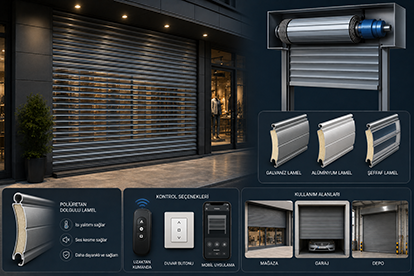
Motorised roller shutters
Galvanised or aluminium slats driven by a tubular motor. Polyurethane-filled slats add a degree of insulation and sound attenuation; perforated or transparent slats let a shop window stay visible while closed.
- SlatsGalvanised / aluminium
- MotorTubular, manual release
- UseShop fronts, stores, car parks
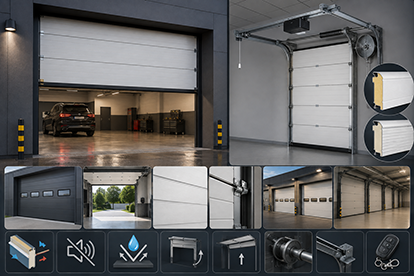
Insulated sectional doors
Polyurethane-filled sandwich panels that slide up under the ceiling. This is the type with the highest thermal and acoustic insulation, and because it takes no space in front of or behind the opening it suits tight loading bays.
- Panel40 mm polyurethane
- TravelSlides overhead, no floor space
- OptionsVision panels, wicket door
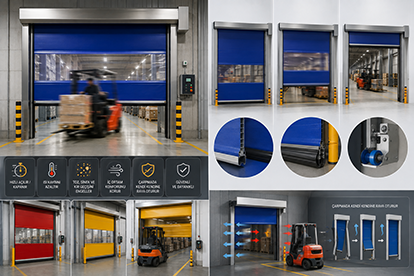
High-speed PVC doors
The answer to doors being left open under heavy forklift traffic. Because they open and close in seconds, heat loss, dust and insect ingress drop noticeably; impact-resistant versions re-seat themselves in the guide rails after a knock.
- Speed0.8 – 2.5 m/s
- UseHigh cycle counts
- FeatureImpact-resistant curtain
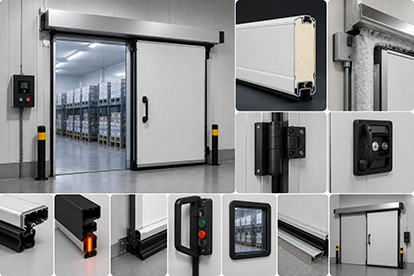
Cold store doors
Thicker insulated panels, tight sealing gaskets and heated seals where needed. At a cold store entrance the real issue isn't panel thickness — it's whether the seal stays tight without icing up.
- PanelHigh insulation class
- SealsTight, heated option
- Add-onPaired with a high-speed door
Residential and complex garage doors
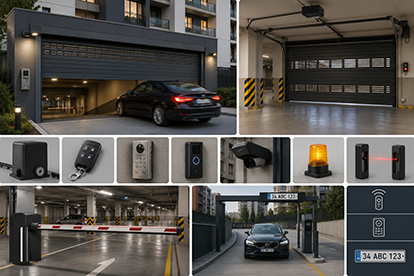
Shared car park doors cycle dozens of times a day; here the motor's cycle rating and the safety hardware matter more than the door itself. Works with remote controls, intercoms and licence plate recognition.
- UseHigh daily cycle count
- AccessRemote / plate / intercom
- SafetyPhotocells + safety edge
Control and automation integration
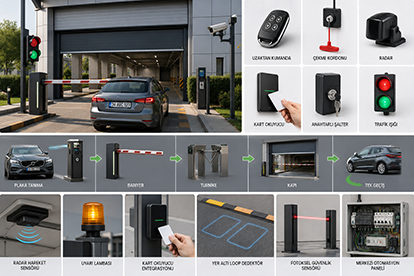
Remote controls, pull cords, radar detectors, card readers and traffic light options. We can run the door on the same logic as barriers, turnstiles and plate recognition so a vehicle moves through in one uninterrupted pass.
- TriggerRemote / radar / card
- IntegrationBarriers, plate recognition
- Add-onTraffic light, audible warning
The Real Constraint: Headroom, Side Room and Depth
Which door can be fitted is decided by the space around the opening, not by budget. A sectional door slides up under the ceiling, so it needs a defined amount of space above the opening (headroom), at both sides and back into the room. Where those clearances don't exist, either a special track system is needed or the product type changes.
This is why we don't quote a firm price over the phone. The width and height of the opening alone aren't enough: headroom, side room, ceiling depth and the power supply point all have to be measured. During the site visit we take these five measurements and confirm on the spot which product physically fits.
| Door type | Headroom | Side room (each side) | Ceiling depth |
|---|---|---|---|
| Sectional — standard track | ~200 – 250 mm | ~100 – 120 mm | Door height + ~500 mm |
| Sectional — low headroom kit | ~100 – 150 mm | ~120 mm | Door height + ~600 mm |
| Motorised roller shutter | Box / coil space ~300 – 450 mm | ~80 – 100 mm | Not required |
| High-speed PVC door | ~400 – 600 mm | ~250 – 350 mm | Not required |
Figures are approximate and vary with the product family, door height and motor type. Exact clearances are confirmed at the site visit.
The four mistakes we see most often in the field
A motor and spring set chosen without calculating cycle frequency, worn out within a year; photocells fitted while the safety edge is skipped; a manual release mechanism that has never once been tested for a power cut; and an insulated door installed with incomplete perimeter seals — that last one cancels out most of the insulation you paid for. On every site we take over, we check these four first.
What the System Is Made Of
Shutter slats
Galvanised or aluminium, solid or polyurethane filled. Filled slats add insulation and sound attenuation; transparent slats keep a shop window visible when closed.
Sandwich panels
The body of a sectional door. A 40 mm polyurethane-filled panel is the standard choice for insulation and rigidity, with finger-trap resistant panel profiles.
Guide rails and side frames
The path the door travels. Track type — standard, low headroom, high lift, sloped ceiling — is chosen from the clearances measured on site.
Torsion shaft, springs and cables
The assembly that balances the door's weight. Spring life is rated in cycles; without a high-cycle spring, heavy use makes failure a matter of time.
Motor and gearbox
Tubular, side-mounted or ceiling type. Door weight matters, but daily cycle count decides the class; heavy use calls for an industrial-grade motor.
Control panel
Open-stop-close buttons, limit settings, force limitation and auto-close timing. Integration outputs are taken from this panel too.
Photocells
They stop the door closing while a vehicle or person is in the opening. One pair is often not enough; position and height are planned around the passage width.
Safety edge (obstruction detection)
A pressure-sensitive strip along the bottom of the door. The moment it touches an obstacle it stops and reverses — covering exactly what photocells cannot see.
Spring and cable break devices
Mechanical devices that stop the door falling if a spring or cable breaks. On heavy sectional doors they are non-negotiable.
Emergency manual release
The chain, crank or battery-backed system that opens the door in a power cut. We test it at handover and demonstrate it to whoever will use it.
Seals and brushes
Bottom, side and top sealing elements. How much your insulation is actually worth is decided by these details more than by the panel.
Controls and integration
Remote controls, pull cords, radar detectors, card readers, traffic lights and outputs for connection to building automation.
Which Door Fits Where?
Product type is decided by the problem the door has to solve, not by price. The table below summarises what each type gives and gives up on the same opening.
| Door type | Insulation | Speed | Best suited to |
|---|---|---|---|
| Motorised roller shutter | Low – medium (higher with filled slats) | Medium | Shop fronts, retail, car park entrances, security first |
| Insulated sectional door | High | Medium | Warehouses, factories, loading bays, heated spaces |
| High-speed PVC door | Medium (effective through speed) | Very high | Heavy forklift traffic, internal partitions, dust and insect control |
| Cold store door | Very high | Low – medium | Cold storage and temperature-controlled entrances |
On busy cold store and factory entrances the most efficient arrangement is usually a pair of doors: an insulated sectional door outside and a high-speed PVC door inside. Daytime traffic runs through the fast door, and the sectional door only closes outside working hours.
Safety: The Hardware a Powered Door Cannot Do Without
A powered door is a moving machine weighing hundreds of kilos. In Europe these products fall under EN 13241, and the safety of powered operation is defined by EN 12453. We supply the following as standard items on every installation — you will never see them listed as options on our quotation.
- Safety edge (obstruction detection)When the bottom edge meets an obstacle the door stops and reverses. For children, pets and low obstacles this is the only real protection.
- PhotocellsThey prevent the door closing while a vehicle or person is in the passage. Position and height are planned around the opening width.
- Spring and cable break devicesMechanical devices that stop the door falling freely if a balance spring or cable fails.
- Emergency manual releaseThe way to open the door during a power cut. It is always tested at handover and demonstrated hands-on to the people who will use it.
Note: this section is general information; product-specific declarations of conformity are handed over with the manufacturer's documentation.
From Site Visit to Handover
-
Free site visit and measurement
Opening dimensions, headroom, side room, ceiling depth and the power supply point are measured on site. We establish together how many times a day the door will cycle and what it has to keep inside.
-
Product selection and quotation
Door type, panel or slat specification, motor class, spring cycle life and safety hardware are settled. The quotation is itemised, with installation and infrastructure work shown separately.
-
Made-to-measure manufacturing
The door is manufactured to the measured opening. Closing the gaps properly, rather than forcing a standard size, is what determines both the insulation and the door's service life.
-
Installation and mechanical adjustment
Tracks and frame are fitted, panels or slats are set, spring torque and motor limits are adjusted. A door whose spring balance is wrong will strain the motor on every cycle.
-
Safety tests and commissioning
Photocells, safety edge and force limitation are tested by real activation. The emergency manual release is operated together with the user.
-
Handover, training and maintenance plan
We explain the controls, the manual release and daily checks. You receive a maintenance schedule based on cycle count, along with the warranty documentation.
Who Is It For?
- Warehouses and logistics centresDoors rated for high cycle counts, fast internal passages and automated dispatch doors.
- Factory loading baysInsulated sectional doors, overhead travel that frees up bay space, and safety hardware suited to vehicle traffic.
- Shop fronts and retail unitsMotorised shutters, transparent slat options and out-of-hours security.
- Apartment and complex car parksHigh cycle counts in shared use, access by remote or plate recognition, and complete safety hardware.
- Cold storage entrancesHigh-insulation panels, tight seals and, where needed, a paired high-speed door.
- Workshop and service entrancesHeavy daily use, sectional doors with wicket access and straightforward manual release.
What Periodic Maintenance Covers
Faults on shutters and sectional doors are rarely sudden; spring fatigue, cable wear and dirty tracks build up over weeks. We plan maintenance around cycle count rather than the calendar: annually under normal use, every six months or more often on busy sites.
- Spring balance and cablesMeasuring spring torque, inspecting cables for wear and checking whether the door holds its position when left half open.
- Tracks, bearings and lubricationCleaning the tracks, checking rollers and bearings, and lubricating moving parts with the right product.
- Safety hardware testingPhotocell alignment, triggering the safety edge and verifying force limitation by real activation.
- Motor, seals and manual releaseMotor brake and limit settings, seal tightness, and testing on site that the emergency release still works.
More about our technical service and maintenance
Our Service Area: 11 Cities, 158 Districts in Marmara
Because we work with our own field team, we respond to service calls without waiting on subcontractors. Same-day response within İstanbul, scheduled appointments in the other cities.
- İstanbul
- Kocaeli
- Bursa
- Sakarya
- Tekirdağ
- Balıkesir
- Çanakkale
- Edirne
- Kırklareli
- Yalova
- Bilecik
Why Cortek?
On shutter and sectional door projects we take the measurements and work out the insulation requirement on site, then deliver the product made to measure for your space and installed by our own team. Safety edges and emergency release mechanisms are supplied as standard on every installation.
Measured on site
No product is selected before headroom, side room and ceiling depth are measured. The door is made to your opening, not to a standard size.
Safety hardware as standard
Safety edge, photocells and emergency manual release are on every installation — never listed as an option on the quotation.
Specified by cycle count
We size the motor and spring set to how often the door will open. That single figure is why some systems wear out early.
Insulation calculated properly
We account for the seals as much as the panel thickness; a leaking perimeter detail cancels the insulation in practice.
Integrated with access systems
We also install barriers, turnstiles and plate recognition, so the door can be designed as part of the whole access flow.
24/7 technical support
A dispatch door stuck shut stops the operation; our own team responds to breakdown calls quickly.
Frequently Asked Questions
Should I choose a roller shutter or a sectional door?
If your priority is security and lower cost, a roller shutter is right; if it's insulation and durability, a sectional door is. At the entrance to a heated or cooled space a sectional door makes a clear difference, while for a shop front a shutter is both sufficient and more economical. Where forklift traffic is heavy, a high-speed PVC door becomes the third option.
My headroom is low — can a sectional door still be fitted?
Usually yes. Low headroom track kits can work in roughly half the space a standard system needs. The motor position and track type change, and the ceiling depth requirement increases slightly. We measure at the site visit and tell you exactly which track type fits.
Will the door open if the power goes out?
Yes. Every installation includes an emergency manual release — a chain, crank or cord depending on the door type. Where outages are frequent and the door is critical, we recommend a battery-backed system. We always test the mechanism with you at handover; a manual release that has never been tried is as good as one that isn't there.
How does the safety edge work?
It's a pressure-sensitive strip along the bottom of the door. The instant it meets an obstacle while closing, it stops the movement and reverses the door. Photocells only see their own beam line; for a child, a pet or a low obstacle beneath that line, the safety edge is the only protection. That's why we fit both together.
Does an insulated door really make a difference?
In heated or cooled spaces, yes — but the panel isn't the only factor. Most of the insulation is lost at the perimeter seals; on a door with a worn bottom seal or badly closed side gaps, a thick panel contributes little. How long the door stays open matters at least as much, which is why we recommend pairing with a high-speed door in heavy traffic.
Where is a high-speed PVC door needed?
Anywhere the time a door spends open is the problem. Under heavy forklift traffic a conventional door opens too slowly and ends up being left open, which effectively ends any control of heat, dust or insects. A high-speed door opens and closes in seconds and removes that habit. It's the usual choice for internal partitions and in front of cold rooms.
Can my existing shutter be motorised?
In most cases yes. If the slats are sound and there's enough coil space, a tubular motor can be fitted, with controls and safety hardware added at the same time. Where slats are deformed or the guides are worn, motorised operation makes the problem worse and we recommend replacement instead. We check the existing condition at the site visit and present both options with costs.
How long do manufacturing and installation take?
Because the door is made to measure, lead time depends on the product type and dimensions; we give a firm date after the site visit. On the installation side a single standard door is usually completed within a day, while multi-door industrial projects are scheduled around the door count.
Is the door affected by wind?
On wide openings and exposed sites, yes. Wind load directly affects panel or slat selection, reinforcement profiles and how the tracks are fixed. On coastal and open industrial sites we calculate this separately and recommend a reinforced product where needed.
How often should maintenance be done?
We go by usage intensity rather than the calendar. Annually is enough under normal use; dispatch and car park doors cycling dozens of times a day need a check every six months, and very busy sites more often. Springs and cables are the parts that fatigue with cycles — catching them before they break is the whole point of maintenance.
Can the door work with barriers and plate recognition?
Yes. Using the dry contact outputs on the control panel, the door can be triggered by plate recognition, a card reader, an intercom or building automation. In residential car parks the setup we install most often lets a recognised vehicle pass through the barrier and the garage door without stopping.
What determines the price?
Five items: the opening dimensions, the door type and panel or slat specification, the motor class and spring cycle life, the scope of safety and automation hardware, and any infrastructure work needed before installation. Differences between quotations for the same opening usually trace back to the motor class and how much safety hardware is included.
Let us measure your opening and choose the right door with you
Send us your address and what the door needs to do. Our team will visit, take the measurements and prepare a made-to-measure product with an itemised quotation. Site visits and quotations are free.