Turnstile Systems
Pedestrian access control — tripod, full height and speed gate turnstiles, integrated with time attendance and fire alarm systems.
A turnstile system controls pedestrian access by authorising every person individually. What separates it from a door or a barrier is this: a turnstile does not simply unlock — it guarantees that one person passes at a time, and it records that passage.
What Does a Turnstile System Solve?
A turnstile system is made up of a mechanism, a control board and a credential reader. The user presents a card, a fingerprint or their face; the system checks authorisation and releases the arm. Once the passage completes, the mechanism locks again.
Its real value lies in the one-person-one-passage principle. When a door is simply unlocked, nobody knows how many people walked in behind the first; at a turnstile every passage is tied to an identity. That solves three problems at once: unauthorised entry, unreliable attendance records, and not knowing how many people are in the building during an emergency. The last one is usually overlooked, yet in a fire evacuation a roll-call list is what matters.
What We Offer
- Tripod, full height and speed gate turnstile options
- Card, fingerprint and facial recognition integration
- Integration with time and attendance systems
- Fire alarm integration for automatic release in emergencies
- High-capacity models for busy access points
Turnstile Types
Three things drive the choice: throughput in people per minute, how critical it is to stop people climbing over, and the architecture of the space. The capacities below are typical field figures.
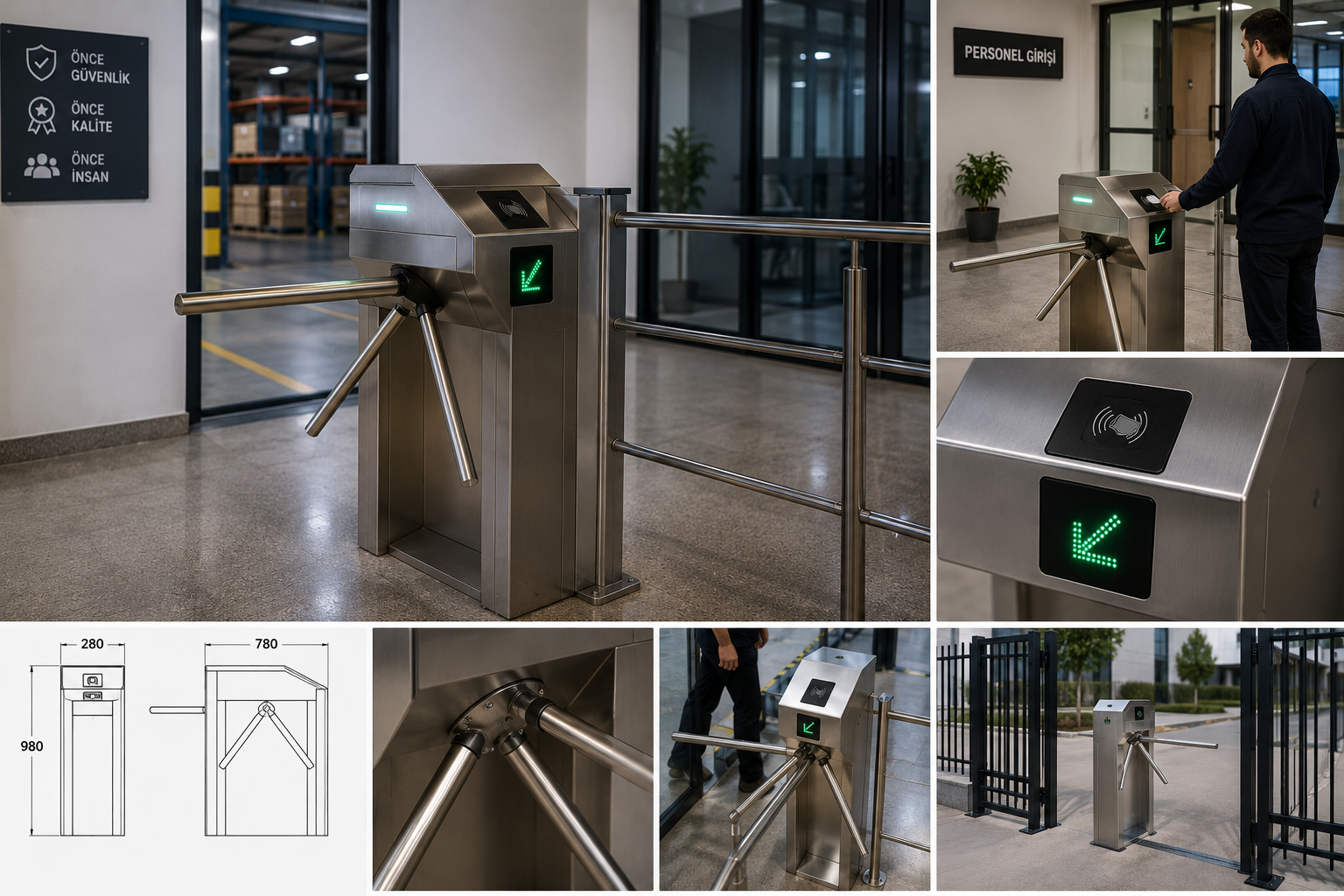
Tripod turnstile
A waist-height three-arm mechanism. The best value option and the standard for factory and office staff entrances. Because it can be climbed over, it is not enough on its own at unsupervised external doors.
- Throughput~25 – 30 people/min
- HeightWaist level
- PlacementIndoor / supervised
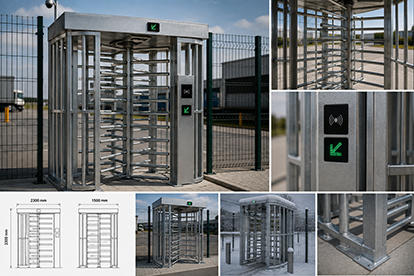
Full height turnstile
A floor-to-ceiling cage structure. It cannot be climbed over or crawled under, making it the only real answer for unsupervised site entrances and perimeter security. A hot-dip galvanised body gives it a long outdoor life.
- Throughput~15 – 20 people/min
- HeightFull height (cage)
- PlacementOutdoor / unsupervised
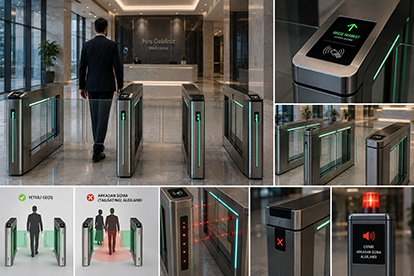
Speed gate
Glass-wing, sensor-driven units for prestige lobbies. The wings open as an authorised person approaches and close once they have passed. A sensor array detects tailgating and raises an alarm. This is the highest-throughput type.
- Throughput~30 – 60 people/min
- AppearanceGlass wing, lobby grade
- ExtraTailgating detection
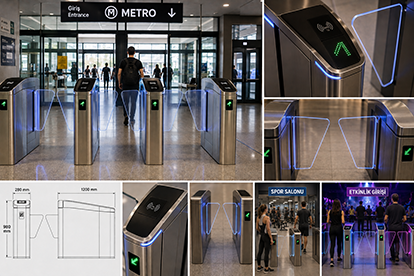
Flap barrier turnstile
The more economical relative of the speed gate, working with acrylic or plastic flaps at high throughput. Widely used at public transport, gym and event entrances.
- Throughput~30 – 40 people/min
- FlapsAcrylic / plastic
- UseHigh-volume flow
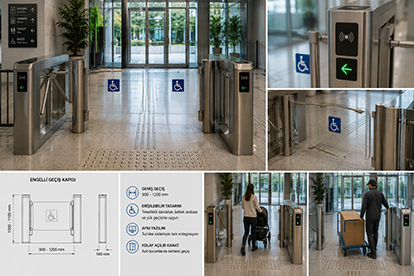
Accessible wide lane gate
A wide-corridor gate for wheelchairs, pushchairs and goods. Installed alongside the turnstile line and running on the same reader and software. An item that should never be treated as optional.
- Clear width~90 cm and above
- UseAccessibility / goods
- ControlSame credential system
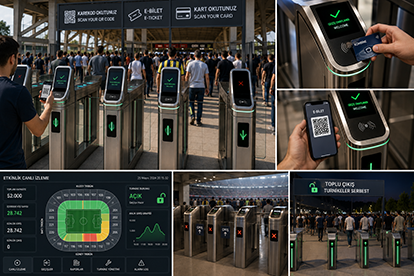
Stadium and event turnstile
For ticketed entry, working with QR codes, e-tickets and card readers, with live headcount data. At the end of an event the units can be switched to free-exit mode for mass egress.
- ValidationQR code / e-ticket
- CountingLive occupancy
- ModeFree exit for egress
Which Turnstile for Which Entrance? — Selection Guide
| Application | Recommended type | Throughput | Credential | Watch out for |
|---|---|---|---|---|
| Factory staff entrance | Tripod (supervised) / full height (unsupervised) | 25–30 /min | Card or face | Shift-change peak load |
| Industrial site perimeter | Full height turnstile | 15–20 /min | Card | Outdoor corrosion, emergency exit door |
| Office and business centre lobby | Speed gate | 30–60 /min | Card, mobile, face | Architectural fit, visitor flow |
| Gym and fitness centre | Tripod or flap barrier | 25–40 /min | Card / QR / fingerprint | Membership software integration |
| Stadium and event venue | Event turnstile (full height or flap) | 20–40 /min | QR code / e-ticket | Mass egress scenario, headcount |
| Metro and public transport | Flap barrier turnstile | 30–40 /min | Card / contactless payment | Continuous duty, accessible lane |
| Hospital and campus | Speed gate + accessible gate | 30–50 /min | Card / mobile | Visitor management, accessibility |
Credentials: Card, Fingerprint, Facial Recognition
How you verify identity matters as much as the turnstile itself. Each method has its place, and most sites end up using two together.
- Proximity card or fobThe most common and most economical method. Fast, but a card can be lent — someone else can pass on it.
- FingerprintSolves the lent-card problem. Gloves, moisture and worn fingertips make reading harder, which is a drawback on production floors.
- Facial recognitionContactless and fast, and unaffected by gloves. Lighting conditions and face coverings do affect performance.
- QR code / mobile credentialPractical for visitors and events, removing the burden of issuing and collecting cards.
Biometric data and data protection
Under Turkish data protection law (KVKK), fingerprint and facial data are special category personal data. Processing them requires the individual's explicit consent, and an alternative such as a card must be offered to anyone who does not consent. Our installations enrol both biometric and card credentials, and we hand over the privacy notice and retention framework with the system. (General information, not legal advice.)
Fire Scenario and Life Safety
A turnstile is an obstacle standing in an escape route. That makes the most critical technical question not access control but release in an emergency. Automatic release on a dry contact signal from the fire alarm panel is a mandatory part of our installations, never an option.
Dry contact from the panel
When the fire alarm panel triggers, a signal reaches the turnstile control board and passage is released.
Open on power loss
Tripod arms drop and wings move to the open position. A turnstile left without power must never stay locked.
Separate door on full height
Even when released, a full height turnstile has low evacuation capacity; a panic-bar emergency exit door must sit beside it.
Who is in the building
Entry and exit records produce the list that tells you, at the assembly point, who is still inside.
The four gaps we see most often in the field
No fire alarm connection at all, no emergency exit door beside a full height turnstile, no accessible lane in the design, and no visitor scenario worked out. These are the first four things we check on every site we take over.
Time and Attendance Integration
The passage records a turnstile produces become payroll input once they reach the right software. A typical integration covers:
- Entry–exit matchingShift start, end and interim exits reported per person.
- Shift definitionsLateness, early leaving and overtime calculated automatically against the shift plan.
- HR and payroll exportData transfer to your existing HR software by file or API.
- Access rules by zoneWho can pass through which door, and at which hours, defined as rules.
If you already run a time and attendance package, we build the integration on top of it — there is no need to replace your system.
From Survey to Handover
-
Free survey and load analysis
We measure how many people pass per minute at peak, the width of the access point, the floor construction and your existing credential system. At sites with shift changes, capacity is calculated around that moment.
-
Specification and quotation
Turnstile type, number of lanes, reader choice and the accessible lane are decided. Fire integration and time attendance connection are itemised separately in the quotation.
-
Infrastructure preparation
Anchor points, floor ducting, power supply and data cabling are prepared. We verify at this stage that the floor can carry and hold the turnstile housing.
-
Installation and mechanical setup
Housings are anchored, arm and wing settings adjusted, and readers mounted. Lane spacing is checked against accessibility dimensions.
-
Integration and fire test
The attendance connection, access rules and visitor scenario go live. The fire alarm trigger is actually tested: we confirm by observation that the turnstiles release when the panel signals.
-
Handover, training and maintenance plan
HR and security teams are shown user enrolment, visitor registration and reporting. The warranty document, test records and maintenance schedule are handed over.
Who Is It For?
- Factory and production facility staff entrancesCapacity sized for shift load, attendance integration, full height units on the perimeter.
- Office and business centre receptionsSpeed gates that suit the lobby architecture, visitor registration, floor-level authorisation.
- Gyms and fitness centresMembership software integration, access closing automatically when a membership expires.
- Stadiums and event venuesQR ticket validation, live headcount, free-exit mode at the end of an event.
- Public transport and metro stationsContinuous duty, high-throughput flap barriers, accessible lane.
- Hospitals, schools and campusesStaff and student segregation, visitor management, an accessible passage lane.
What Scheduled Maintenance Covers
Turnstiles run thousands of cycles a day, and a fault turns straight into a queue at the entrance. We recommend every three to six months at busy sites and once a year at medium-traffic offices.
- Mechanical inspectionArm and wing alignment, damper and spring settings, mechanism lubrication, anchor tightness.
- Fire scenario testRelease on panel trigger is re-verified — the single most important item in the service.
- Readers and softwareRead performance, software updates, and confirmation that attendance export still runs cleanly.
- User list hygieneClearing records for departed staff and expired visitor credentials.
More on our technical service and maintenance
Our Service Area: 11 Provinces, 158 Districts
Because we work with our own field team, we respond to breakdown calls without waiting on subcontractors. Within İstanbul we aim for same-day response; in the other provinces we work by scheduled appointment.
- İstanbul
- Kocaeli
- Bursa
- Sakarya
- Tekirdağ
- Balıkesir
- Çanakkale
- Edirne
- Kırklareli
- Yalova
- Bilecik
Why Cortek?
We install turnstile systems integrated with your time and attendance infrastructure, and we guarantee automatic release in an emergency through the fire alarm connection. High-capacity models for busy access points are held in stock.
No handover without a fire test
We verify on site that the turnstiles release on the panel signal and record the result on the handover form.
Works with your existing system
You do not have to replace the attendance software you already use; we build the integration on top of it.
Capacity sized for peak, not average
Lane count is calculated from shift-change peak load rather than daily averages. That is where the queue forms.
High-capacity models in stock
Models for busy access points are held in stock, so projects move without waiting on supply.
Accessibility built in
The accessible lane is planned as a standard part of the project rather than added afterwards.
24/7 technical support
A turnstile fault locks up the shift entrance. On a call we first talk you through release, then schedule the field team.
Frequently Asked Questions
Do the turnstiles open in a fire?
On a correctly installed system, yes. A dry contact signal from the fire alarm panel to the turnstile control board releases passage the moment the alarm sounds. The units are also set to fail open if power is lost entirely. We test that connection before handover — it is the item most often skipped in the field.
Should I choose a tripod or a speed gate?
Throughput and placement decide it. At a supervised staff entrance, a tripod is the sensible value choice. In prestige lobbies with visitor traffic, where tailgating has to be caught, and where throughput exceeds 40 people a minute, a speed gate is the better answer. At unsupervised outdoor entrances neither is enough — that calls for a full height turnstile.
Can someone climb over a turnstile?
Tripods and flap barriers can be climbed over; they deter rather than physically prevent. That is why unsupervised points use full height units. Speed gates detect tailgating with a sensor array and raise an alarm, but the wing height is still not a physical barrier.
Will it integrate with my existing attendance software?
In most cases, yes. We deliver the passage records produced by the turnstile controller to your existing software by file export or API. During the survey we check which package you run and which integration methods it supports. It is rare for a situation to require replacing your software.
Is using facial recognition or fingerprints compliant?
Biometric data is special category personal data; processing requires the individual's explicit consent, and an alternative such as a card must be offered to anyone who declines. Our installations enrol both biometric and card credentials, and we hand over the privacy notice and retention framework with the system. We also recommend reviewing your policy with your legal adviser.
Which method suits staff wearing gloves?
Fingerprints struggle on production floors: gloves, moisture, cuts and worn ridges all make reading harder. Cards or facial recognition are more stable in those environments. With facial recognition we assess lighting conditions and the effect of helmets or masks during the survey.
How is accessibility handled?
A wide-corridor gate is installed alongside the turnstile line, running on the same reader and software rather than as a separate system. Wheelchairs, pushchairs and goods pass through that lane. We plan it as a standard part of the project.
How do visitors get in?
Either a temporary card issued at reception, a single-use QR access code, or a guard opening manually. In buildings with high visitor volume the QR route removes the burden of issuing and collecting cards entirely. If this is not decided at design stage, the system stalls on day one.
Can turnstiles be installed outdoors?
Yes, but material choice is critical. Outdoors you need a hot-dip galvanised or stainless body, sealed readers and an appropriate ingress protection rating. In salt-laden coastal environments we specify a higher corrosion-resistant stainless grade. A standard indoor turnstile will rust within a few years outside.
How many lanes do I need?
Calculated from the peak, not the average. If 300 people arrive within 10 minutes at shift change, that is 30 people a minute; a single tripod lane only just keeps up, so two lanes are needed to avoid a queue. We work this calculation through with you during the survey.
What determines the price?
Five items: turnstile type (tripod, flap, speed gate, full height), lane count, credential method, software and integration scope (attendance, fire, visitors) and body material. For the same lane count, the gap between quotations usually comes from body quality and software scope.
How long does installation take?
A single-lane installation with infrastructure in place is mounted and commissioned in one day. Multi-lane lobby installations, attendance integration and fire panel testing extend that to two to four days. Floor ducting and anchor preparation are scheduled as additional days.
Let us see your entrance and size the lanes to your peak load
Send us your address and your peak staff or visitor numbers; our team will visit for a survey and prepare an itemised quotation. Both the survey and the quotation are free.