Licence Plate Recognition Systems
Authorised vehicles pass without stopping, visitors are logged — plate recognition integrated with your barriers and gates.
A licence plate recognition system (ANPR/LPR) reads a vehicle's plate with a camera, checks it against an authorised list and opens the barrier or gate automatically. No card, no remote, no ticket — the driver does not even have to open a window.
How Does Plate Recognition Work?
An ANPR (automatic number plate recognition) system works in four steps: the camera captures the vehicle, the software locates the plate within the image, optical character recognition converts the characters to text, and the resulting plate is matched against the database of authorised vehicles. On a match, a relay fires through the control board and the barrier or automatic gate opens. The whole sequence typically takes under a second.
What determines success is not the software but where the camera is mounted and at what angle. A mid-range system installed at the right angle will out-read an expensive system pointed badly. That is why our survey starts with the camera line: where the vehicle will stop, the plate height relative to the camera, horizontal and vertical angles, and how sunlight by day and headlights by night strike the lens.
What We Offer
- ANPR cameras with IR illumination for night and adverse weather reading
- Relay-level integration with barriers, automatic gates and turnstiles
- Resident (whitelist), visitor and blacklist management
- Entry–exit matching, duration calculation and payment system integration
- Plate enrolment, access logs and reporting from a web or mobile panel
- Hybrid operation with UHF vehicle tags (tag plus plate verification)
- Data protection compliant installation: signage, retention periods and role-based access
Plate Recognition Solutions
The same technology is configured differently depending on the site. These are the packages we install most often.
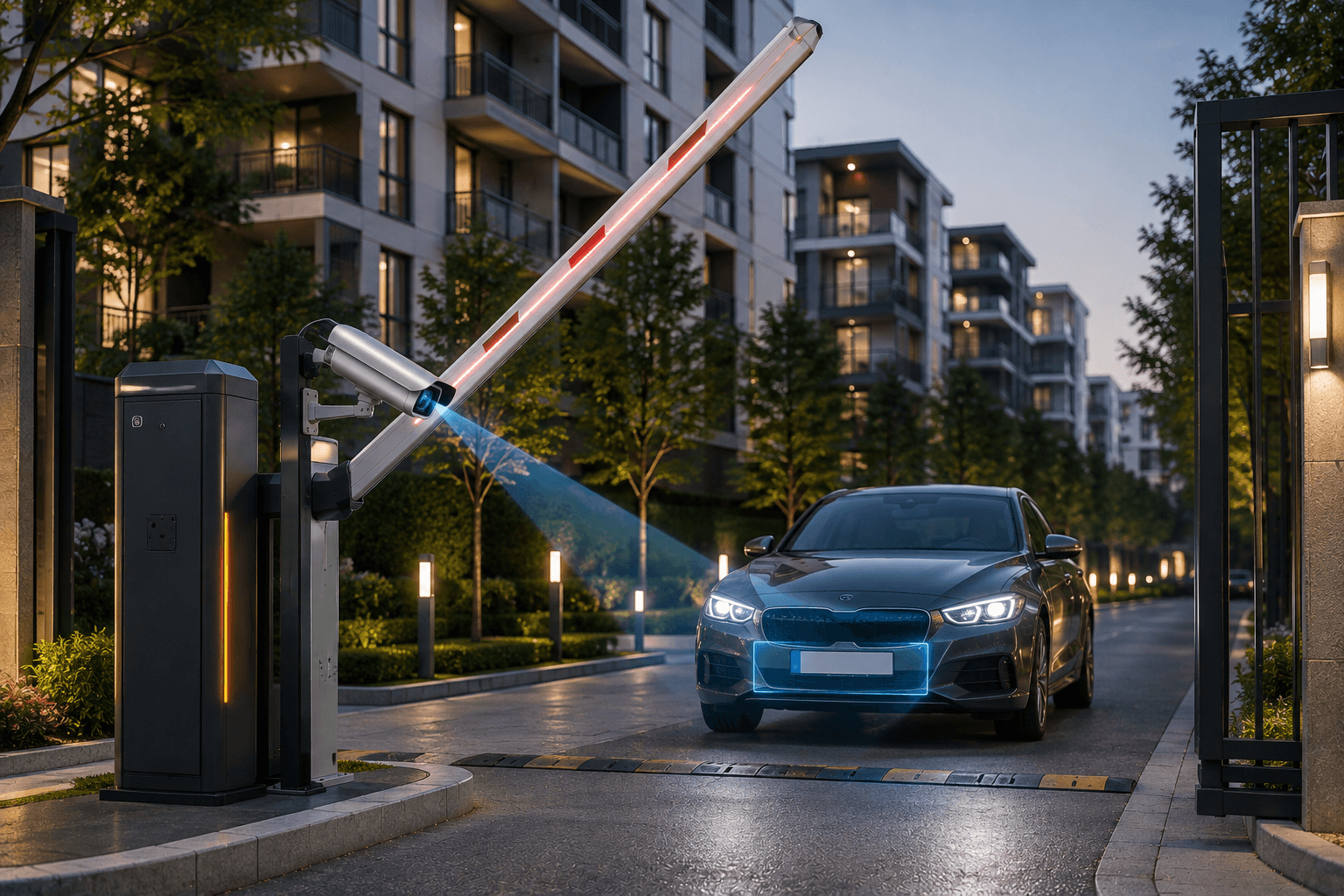
Residential complex access
Residents' plates are enrolled once and the barrier opens as the vehicle approaches. No more distributing remotes, deleting lost ones or chasing access from residents who have moved out.
- Cameras1 entry (or 1+1)
- ManagementWeb / mobile panel
- IntegrationBarrier or gate
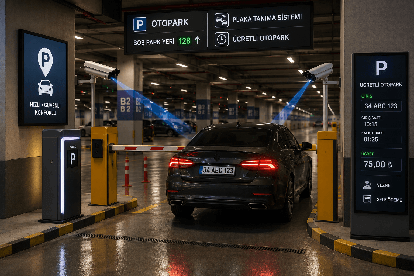
Paid car park management
Cameras at entry and exit match the plate and calculate the stay. Lost tickets, ticket queues and paper costs disappear, and the system ties into pay stations or self-service payment.
- CamerasEntry + exit
- CalculationDuration-based tariff
- IntegrationPay station / self-service
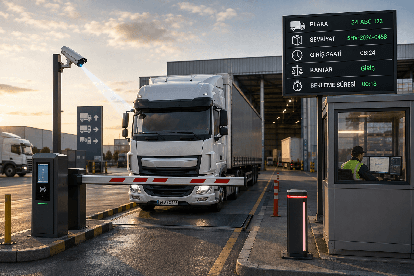
Industrial and logistics entrances
Plate checks matched against dispatch records at truck entrances. Integrated with weighbridge and dispatch software, it makes arrival times and waiting durations reportable rather than anecdotal.
- CameraHeavy vehicle angle
- IntegrationWeighbridge / dispatch
- ReportingDwell time analysis
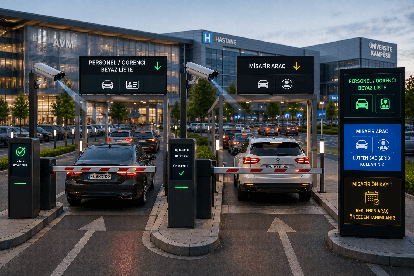
Shopping centres, hospitals, campuses
Queue management under heavy traffic. Staff and student vehicles pass on the whitelist while visitors are handled in a separate lane, with pre-registration for expected vehicles.
- LanesMulti-lane setup
- UsersStaff / visitor
- ExtraVisitor pre-registration
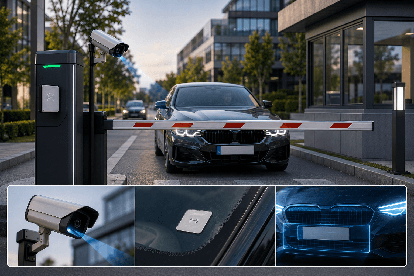
UHF tag + plate hybrid
A UHF tag on the windscreen is read at long range, while plate recognition confirms the tag belongs to that vehicle. This stops a removed or stolen tag being used on another car.
- ReadingLong range (UHF)
- VerificationPlate matching
- UseHigher security
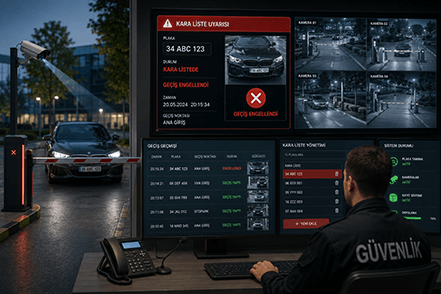
Security monitoring and blacklists
Beyond blocking access, the system raises an immediate alert at the security desk when a flagged plate appears. Installed alongside cameras, every passage is archived with an image.
- AlertReal-time notification
- ArchivePassage image
- IntegrationCamera systems
What the System Is Made Of
These are the line items to check when you compare quotations. Cheaper-looking offers usually leave out the network infrastructure, the mounting post or the uninterruptible power supply.
ANPR camera
A camera built for plate reading. A varifocal lens, fast shutter and IR illuminator let it resolve the plate at night and against headlight glare. A standard security camera cannot do this job.
Processing unit
Recognition runs either on the camera's embedded processor or on a separate server. Embedded units need less upkeep; servers suit multi-lane installations.
Management software
Plate enrolment, user management, access logs, blacklists and reporting, from a web or mobile panel the site manager runs themselves.
Network infrastructure
PoE switch, CAT6 cabling and fibre where needed. When the link between camera and software is weak, the system looks like it "can't read" — the fault is usually the network.
Mounting post and housing
The camera has to stay fixed at the right height and angle. A post that vibrates in the wind measurably lowers the read rate.
Triggering (loop / video)
The camera is triggered either by a ground loop detector or by continuous video analysis. Video triggering needs no excavation; a loop is more stable in heavy, mixed traffic.
Relay output
The dry contact output that passes the recognition result to the barrier or gate control board. This is where integration physically happens.
Supplementary lighting
The camera's IR is enough in most cases, but on completely dark, dusty or foggy approaches extra lighting noticeably improves read quality.
Uninterruptible power supply
Keeps camera and software alive through a power cut. Without one, passages during the outage go unrecorded.
Recording and storage
Plate text, timestamp and vehicle image are stored. Retention is set by both disk capacity and your data protection policy.
Visitor handling
Video intercom, security approval or advance plate registration. If you do not design what happens to a vehicle that is not on the whitelist, the system stalls on day one.
Data protection set
Camera signage, privacy notice, defined retention period and role-based panel access. We treat this as part of the installation, not paperwork added later.
What Actually Sets the Read Rate: Installation
The high accuracy figures printed in brochures are laboratory values under ideal conditions. In the field the parameters below decide the outcome, and we measure all of them during the survey.
| Parameter | Recommended range | What happens outside it |
|---|---|---|
| Horizontal angle to plate | Under 30°, ideally 15–20° | Characters skew and similar letters get confused |
| Vertical angle | Under 30°, ideally 20° | The plate flattens and OCR error rate rises |
| Reading distance | 3 – 8 m depending on lens | Too close and the plate leaves frame; too far and resolution drops |
| Camera height | Near plate level, 0.9 – 1.5 m | High mounting ruins the vertical angle |
| Vehicle speed | Under 20 km/h at the read point | Motion blur, missed frames |
| Illumination | IR illuminator, plus extra light if needed | Night read rate falls sharply |
| Camera orientation | Not facing direct sun or headlights | Reading can stop entirely at certain hours |
The four mistakes we see most often in the field
The camera mounted too high, an existing security camera pressed into service for plate reading, no visitor scenario designed at all, and a system handed over without ever being tested at night. These are the first four things we check on every site we take over.
From Survey to Handover
-
Free survey and camera line analysis
We establish where the vehicle will stop, the camera angle, the distance and the lighting conditions on site — including how sunlight by day and headlights by night hit the lens.
-
Specification and quotation
Camera count, triggering method, software modules and integration scope are decided. Network infrastructure and mounting posts are itemised separately rather than buried in a lump sum.
-
Infrastructure: post, cabling, network
The mounting post or bracket goes up, the PoE run is pulled and a loop slot is cut if required. The control line to the barrier or gate board is prepared.
-
Installation and calibration
The camera is aligned and the lens focus and region of interest are set. This is done separately for day and night — a single setting will not give the best result for both.
-
Integration and site testing
Barrier or gate triggering, the whitelist and the visitor scenario are tested. We run live passes with vehicles of different makes, colours and levels of dirt to measure the actual read rate.
-
Handover, training and compliance documents
The manager is shown plate enrolment, visitor registration and reporting. Camera signage, the privacy notice and the retention period definition are handed over.
Data Protection Responsibility
A vehicle plate and its image count as personal data to the extent they can be linked to an individual. Under Turkish data protection law (KVKK), the management company, business or institution operating the system becomes a data controller. We hand the installation over with that framework already in place.
- Notice and transparencyCamera signage at the entrance; a privacy notice for residents or employees.
- Retention periodHow long access records are kept is defined in writing, with automatic deletion configured accordingly.
- Access controlWho can open the panel and who can view records is set by role.
- Purpose limitationThe system is installed for access control; extending it to purposes such as staff tracking requires separate legal assessment.
Note: this section is general information, not legal advice. We recommend reviewing your own policy with your legal adviser.
Who Is It For?
- Residential complexes and housing estatesResident whitelist, visitor handling, an end to distributing remotes.
- Paid car parks and shopping centresTicketless entry and exit, duration-based charging, shorter queues.
- Factories and logistics centresTruck arrival records, weighbridge and dispatch integration, dwell time reporting.
- Hospital and school campusesStaff and student whitelists, a separate visitor lane, peak-hour management.
- Hotels and office buildingsGuest plates matched to reservations, VIP vehicle recognition.
- Institutional and public buildingsBlacklist alerts, passage archive, real-time notification to the security desk.
What Scheduled Maintenance Covers
Unlike mechanical systems, maintenance here is mostly optical and software-side. We recommend twice a year, or every three to six months at busy sites.
- Optical inspectionLens cleaning, housing seals, and whether the camera alignment has drifted.
- Read rate testingLive vehicle testing measured separately by day and by night.
- Software and dataUpdates, disk usage, and verification that the retention policy is actually running.
- List hygieneClearing out unused resident records and updating the blacklist.
More on our technical service and maintenance
Our Service Area: 11 Provinces, 158 Districts
Because we work with our own field team, we respond to breakdown calls without waiting on subcontractors. Within İstanbul we aim for same-day response; in the other provinces we work by scheduled appointment.
- İstanbul
- Kocaeli
- Bursa
- Sakarya
- Tekirdağ
- Balıkesir
- Çanakkale
- Edirne
- Kırklareli
- Yalova
- Bilecik
Why Cortek?
With plate recognition, the real work is putting the camera in the right place and making it talk cleanly to the access hardware. Because the same team installs the barrier, the gate and the camera, no responsibility gap opens up between systems.
We start with angle and light
Before anything is mounted we measure where the vehicle stops, the angle and the lighting. That step is what sets the read rate.
Access hardware from one source
We supply the barrier, gate and turnstile too, so integration never turns into an argument over whose equipment is at fault.
No handover without a night test
We test by day and by night separately and record the measured read rate on the handover form.
Compliance built in
Signage, retention period and role-based panel access are part of the installation, not a document produced afterwards.
24/7 technical support
When access control stops, the site locks up. On a call we first talk you through manual passage, then schedule the field team.
Proven on site
You can review completed installations at residential, school, industrial and retail entrances in our references.
Frequently Asked Questions
How accurate is plate recognition?
On a system installed at the right angle and distance the read rate is very high, and what decides it is the installation rather than the brand. Dirty, bent, snow- or mud-covered plates and non-standard foreign plates all reduce it. That is why we share the measured read rate in writing at handover and always define a visitor or manual passage fallback.
Does it work at night and in bad weather?
Yes. The IR illuminator on an ANPR camera is designed to read off the reflective surface of the plate, so the plate stays legible in darkness. Heavy fog, packed snow and mud covering the plate are the hardest cases. On completely dark approaches we recommend supplementary lighting.
Can I use my existing security camera for plate reading?
In practice, no. A security camera is set up to cover a wide scene, so the plate occupies few pixels and blurs while the vehicle moves. On an ANPR camera the lens, shutter speed and IR illumination are optimised specifically for plates. The right setup is to keep your existing camera for the wider view and give recognition its own dedicated camera.
Can plate recognition be added to my existing barrier?
In most cases, yes. All that is needed is a control board that accepts an external dry contact input, which nearly all current boards do. We check the board model during the survey. If it is very old, replacing just the board is usually enough — the whole barrier does not need changing.
How much does the vehicle need to slow down?
Speeds under 20 km/h at the read point cause no problems, and at a barrier the vehicle has to stop anyway, so the condition is met naturally. On free-flowing entrances without a barrier, camera and lens selection is adjusted accordingly.
How do visitors get in?
One of three routes: security approval via video intercom, the resident registering the visitor's plate in advance through the panel, or a guard opening manually. If this is not decided at the design stage the system stalls immediately, so we always raise it during the survey.
How many plates can be registered?
In practice we do not run into a limiting threshold; lists of several thousand vehicles for large complexes and campuses are handled comfortably. What matters is list hygiene: if records for departed residents and former staff are never cleared, the list gradually becomes a security hole.
Is an internet connection required?
Access control runs on the local network, so gates and barriers keep opening even if the internet goes down. Connectivity is only needed for remote management, the mobile panel and off-site reporting. At critical sites we design with that distinction in mind.
Are plate records covered by data protection law?
Plates and vehicle images count as personal data to the extent they can be linked to an individual, and the operating management or business becomes the data controller. We install signage, the privacy notice, retention settings and role-based panel access together with the system. We also recommend reviewing your policy with your legal adviser.
How does it differ from a UHF tag system?
A UHF tag reads quickly at long range, but the tag belongs to the windscreen, not the vehicle — it can be moved to another car. Plate recognition reads the vehicle's own identity but is affected by dirt and angle. The most robust setup uses both: the tag makes passage fast, and the plate check confirms the tag is on the right vehicle.
What determines the price?
Five items: camera count (single entry, entry and exit, or multi-lane), camera class, software modules (payment, weighbridge integration, mobile panel), infrastructure work (post, PoE run, loop slot) and integration scope. The gap between quotations usually comes from software modules and infrastructure.
How long does installation take?
On a single-entry installation with infrastructure in place, mounting, calibration and integration finish in one to two days. Erecting a post, pulling cable runs or integrating a payment system extends that. We also schedule a separate evening visit for night calibration.
Let us see your entrance and quote against a measured read rate
Send us your address and daily vehicle count; our team will visit, work out the camera line and prepare an itemised quotation. Both the survey and the quotation are free.