Technical Service & Maintenance
Planned maintenance and fast breakdown response — keeping the system running, regardless of who installed it.
Periodic maintenance agreements and 24/7 breakdown response for automatic doors, barriers, turnstiles, shutters, cameras and automation systems. A service built on dealing with a system before it fails, not after — including systems installed by other companies.
What Does Maintenance Actually Solve?
Technical service is two separate jobs, and confusing them makes both worse: planned maintenance and breakdown response. The first catches a fault before it happens; the second closes a fault that already has. Sites running on the second alone end up intervening at the most expensive and least convenient moment every single time.
Where that difference shows most clearly isn't cost — it's timing. A fatigued barrier spring is a fifteen-minute part swap during planned maintenance; left until it snaps, the same job happens at nine in the morning with a queue of cars at the gate. That's why we set the maintenance schedule from how many times a day the system operates, not from a catalogue interval.
What We Offer
- Periodic maintenance agreements (monthly / annual)
- 24/7 breakdown reporting and fast on-site response
- Original spare parts and guaranteed workmanship
- Field support across the Marmara Region
- System renewal and modernisation consulting
Our Service and Maintenance Offering
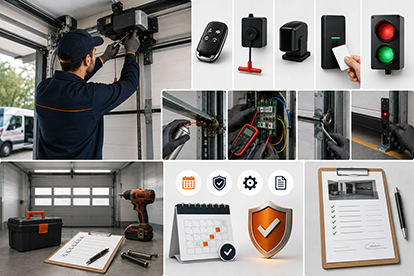
Periodic maintenance agreements
Maintenance scheduled monthly or annually and carried out against a checklist. After every visit you receive a written report covering what was done and what needs watching.
- IntervalMonthly / 6-monthly / annual
- ScopeChecklist + report
- BenefitPriority on call-outs
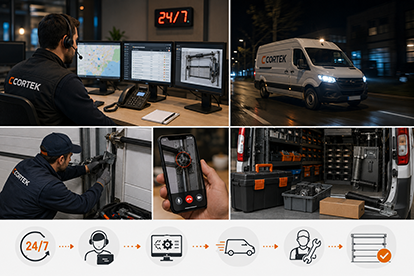
24/7 breakdown response
Breakdowns can be reported at any hour. Every call is assessed remotely first, so the team that sets off already knows what the problem is and carries the likely part with them.
- ReportingPhone / WhatsApp
- First stepRemote diagnosis
- TargetSame day within İstanbul
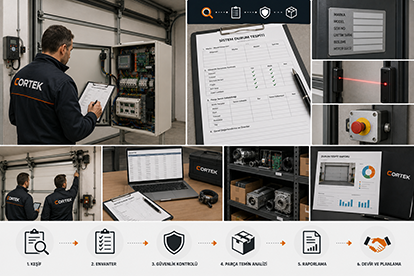
Taking over existing systems
We take on systems installed by other companies. The first job is establishing what condition the system is really in: a make and model inventory, missing safety hardware and spare part availability.
- OutputWritten condition report
- ContentsInventory + gap list
- DecisionMaintain or renew
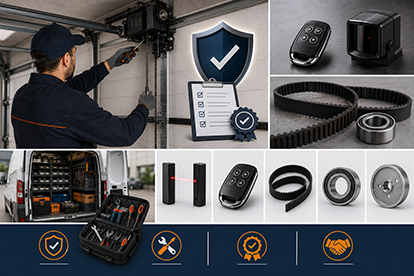
Spare parts and guaranteed workmanship
Parts replaced and work carried out are covered by our guarantee. We keep fast-moving items — photocells, remotes, belts, bearings, hard drives — on the vehicle to reduce the need for a second visit.
- PartsOriginal / equivalent option
- LabourGuaranteed
- StockConsumables on the vehicle
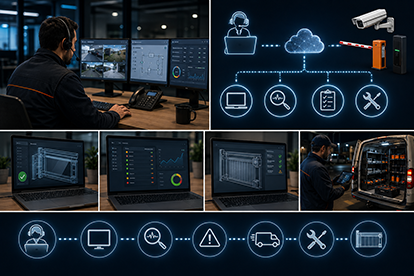
Remote diagnosis
On camera, access control and automation systems a share of calls is resolved by connecting remotely. Even where it isn't, we've narrowed down the cause before anyone drives out.
- ScopeCameras, access, automation
- BenefitShorter waiting time
- ResultOne visit, right part
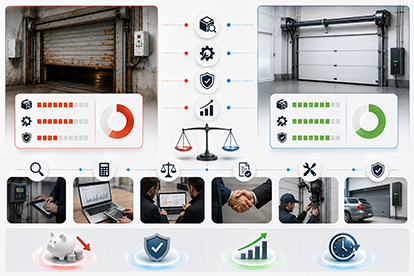
Renewal and modernisation
Not every old system deserves replacing — and some don't deserve keeping alive either. Looking at part availability, annual fault count and safety gaps, we show you in figures which option costs less.
- AnalysisFault history + part supply
- OptionPartial renewal possible
- OutputComparative costing
The Real Measure: Response Time or Resolution Time?
"Fast response" on its own says nothing. There are two distinct times worth measuring: how long until the team is on site, and how long until the fault is closed. A provider can cut the first to two hours and stretch the second over three days — in which case nothing has actually improved.
That second figure is decided less by team speed than by whether the part is on hand. So when we sign an agreement we build an inventory of the systems on site and keep the fast-moving items on the vehicle. On critical sites we go one step further and recommend holding certain parts in your own stock — because no service contract shortens a supplier's lead time.
| Level | On-site target | Maintenance interval | Best suited to |
|---|---|---|---|
| Standard | Scheduled appointment, within business days | Annual | Homes, small businesses, low usage |
| Priority | Same-day target within İstanbul | Every 6 months | Residential complexes, offices, retail |
| Critical | Same day + out-of-hours call-outs | Every 3 – 6 months | Factories, warehouses, malls, cold storage |
Response targets depend on distance, traffic and part availability. The applicable target is stated in writing in the agreement.
The four things we find most often on sites we take over
Camera systems that appear to work but aren't recording; photocells and safety edges removed or disabled, so they no longer protect anything; emergency manual release mechanisms untested since installation; and equipment whose make and model is written down nowhere, so the part can only be identified by dismantling it. Our takeover report starts with these four.
Systems We Maintain
Automatic doors
Pedestrian, garden and industrial doors. Checking the motor, tracks, sensor alignment and force settings.
Barriers
Spring balance, boom balance, loop detector calibration and mechanical checks. The item that needs attention most often in busy car parks.
Turnstiles
Arm mechanism, lock solenoid, reader connections, and testing the fail-safe release used in an emergency.
Shutters and sectional doors
Spring torque, cable wear, track cleaning, safety edge and a manual release test. Our shutter and door systems.
High-speed PVC doors
The group needing the most frequent attention because of cycle count: curtain, belts, photocells and motor brake.
Camera systems
Verifying every channel actually records, drive health, lens cleaning and night image checks. Our camera and alarm systems.
Alarm systems
Triggering each sensor individually, measuring batteries, and confirming the siren and mobile notifications arrive.
Licence plate recognition
Measuring read accuracy, checking camera angle and lighting, and testing the database and integrations.
Access control systems
Card readers, lock and button wiring, reviewing permission lists and testing the fire release scenario.
Smart home and building automation
Verifying each scene, sensor batteries, software updates and network checks. Our automation systems.
Network and recording infrastructure
Switches, PoE power budget, cable terminations and reviewing recorder temperature and drive reports.
Uninterruptible power supplies
Battery health and measured runtime under real load. The most skipped item in maintenance and the most missed during an outage.
How Often Does Each System Need Attention?
Intervals are set by usage intensity, not the calendar. The figures below are for typical use; on sites with high daily cycle counts the interval shortens.
| System | Typical use | Heavy use | Critical check item |
|---|---|---|---|
| Barrier | Every 6 months | Every 3 months | Spring and boom balance |
| Turnstile | Annual | Every 6 months | Lock solenoid, emergency release |
| Automatic / sectional door | Annual | Every 6 months | Springs, cables, safety edge |
| High-speed PVC door | Every 6 months | Every 3 months | Curtain, belts, motor brake |
| Cameras and recording | Annual | Every 6 months | Recording verification, drive health |
| Alarm system | Annual | Every 6 months | Sensor batteries, notification test |
| Uninterruptible power supply | Annual | Every 6 months | Battery health and runtime |
What We Can and Cannot Do on Systems We Take Over
Maintaining systems installed by another company is a significant part of what we do. But being clear from the outset beats disappointment later:
- We can: maintain and repairWe maintain and repair the mechanical and electronic components of common brands. The brand itself is rarely the obstacle.
- We can: complete missing safety hardwareWhere photocells, safety edges or emergency mechanisms are missing, we fit them without replacing the system.
- We cannot: manufacture an unavailable partOn discontinued equipment or brands with no local representation, a part may simply be unobtainable. We then present equivalent parts or partial renewal with costs.
- We cannot: guarantee someone else's installationWe can't guarantee wiring and mounting we didn't carry out; the parts and labour we supply are under our own guarantee.
How a Maintenance Agreement Works
-
Free condition survey
We inventory every system on site: make, model, age, safety hardware and existing faults. The output is a written condition report.
-
Scope and service level
Which systems are covered, the maintenance interval, the response target and the terms for parts and labour are all agreed. Every item is written into the contract.
-
First visit and closing the gaps
The first visit under an agreement is a reset: accumulated deficiencies are cleared, safety hardware is completed, and the system starts from a known state.
-
Planned maintenance schedule
Visits are planned and confirmed in advance. Each one ends with a report of the work done and the items to keep watching.
-
Breakdown call flow
The call is logged, diagnosed remotely where possible, and the team travels with the likely part. Where a fault can't be closed immediately, our priority is a safe temporary fix that keeps the system usable.
-
Annual review
We go through the year's fault records together. Where faults repeat, we set out in figures whether renewal now costs less than continuing to maintain.
Who Is It For?
- Systems installed by other companiesBrand-independent maintenance and repair, with a written condition survey before takeover.
- Residential complex managementA single agreement covering barriers, car park doors, cameras and turnstiles across the site.
- Factories and warehousesShort intervals for high-cycle doors, out-of-hours call-outs and planning for critical spare stock.
- Shopping centres and business parksAutomatic door and turnstile maintenance under heavy footfall, with work scheduled outside opening hours.
- Private villas and homeownersAnnual maintenance or one-off service for gates, garage doors, cameras and alarms.
- Cold storage and food facilitiesSeals, sealing performance and high-speed door maintenance, with priority response where downtime is costly.
What the Agreement Covers
Scope is what causes most disputes in service contracts. Our standard approach is the following, and it's written plainly into the quotation:
- Included: planned maintenance visitsChecklist-based maintenance, adjustment, cleaning, lubrication and safety testing at the agreed interval.
- Included: reporting and priorityA written report after every visit, and priority over non-contract customers on breakdown calls.
- Priced separately: spare partsReplacement parts are priced separately or included up to an agreed limit, depending on the contract. Which model applies is stated in the contract.
- Priced separately: damage and external causesDamage from vehicle impact, flooding, lightning and similar external causes is assessed separately from periodic maintenance.
Our Service Area: 11 Cities, 158 Districts in Marmara
Because we work with our own field team, we respond to service calls without waiting on subcontractors. We aim for same-day response within İstanbul and work by scheduled appointment in the other cities.
- İstanbul
- Kocaeli
- Bursa
- Sakarya
- Tekirdağ
- Balıkesir
- Çanakkale
- Edirne
- Kırklareli
- Yalova
- Bilecik
Why Cortek?
Beyond the systems we install ourselves, we also maintain and repair automatic doors, barriers, turnstiles and camera systems fitted by other companies. With our field teams across the Marmara Region, we aim to provide on-site support the same day.
Brand-independent service
We don't mind who installed the system. Before taking it over we survey it and tell you in writing what we can commit to.
Our own field team
No subcontractor chain. The people taking the call and the people arriving on site are the same organisation, so nothing gets lost in between.
Every system, one contract
Doors, barriers, turnstiles, cameras and automation don't get split across suppliers: one contact, one schedule, one report.
Written reporting
Every visit ends with a record of what was done and what to watch. For site management boards that difference matters.
Safety hardware first
If photocells, a safety edge or an emergency release are missing, we report it on the first visit and fit them.
Honest renewal advice
We show you in figures where maintaining costs more than replacing. We don't drag a failing system along to keep a contract alive.
Frequently Asked Questions
My system was installed by another company — will you still maintain it?
Yes, it's a significant part of our work. We start with a free condition survey covering the make and model inventory, missing safety hardware and spare part availability. After that report we tell you clearly what we can take on, and if there's equipment we won't be able to source parts for, we say so upfront.
How quickly do you respond to a breakdown?
We aim for same-day response within İstanbul and work by scheduled appointment in the other cities. Customers with a maintenance agreement take priority in the call queue. Response times depend on distance, traffic and part availability; the applicable target is stated in writing in the agreement.
Can I get a one-off service without a contract?
Yes, we take one-off calls. The difference is that contract customers get priority, and because we already hold their system inventory the team leaves with the right part. On non-contract calls the first visit is often diagnostic, and a second visit may be needed if a part is required.
Are spare parts included in the maintenance agreement?
The standard agreement includes labour and planned maintenance; replacement parts are priced separately. We can also set up a scope that includes parts up to an annual limit. Which model applies is written plainly into the contract — we don't leave this to be settled later.
How often is maintenance needed?
It depends on usage intensity. Annually is enough in homes and low-usage settings. For systems cycling dozens of times a day — car park barriers, mall turnstiles, warehouse doors — we recommend every three to six months. The interval table on this page shows typical figures; we finalise them against your site's actual cycle count.
What happens if a part can't be found?
On discontinued equipment or brands with no local representation this is a real risk. We present three options with their costs: an equivalent part, partial renewal of the equipment, or full replacement of the system. We also state how long each option buys you, so the decision isn't made on guesswork.
Should I keep maintaining the system or replace it?
Three figures decide it: annual fault count, part availability and the state of the safety hardware. On a system that stops several times a year, whose parts are hard to source and whose safety hardware is incomplete, maintenance is usually an expensive way of postponing. We produce this comparison at the annual review — and if the numbers don't point to replacement, we say that too.
How does a site-wide agreement work for complex management?
The barriers, car park doors, cameras, turnstiles and alarm systems across the site go into one contract: one point of contact, one schedule, one report. Visits are notified in advance so management can inform residents. The written report after each visit also preserves the system's history through changes in management.
Can faults be resolved remotely?
On camera, access control and automation systems a share of calls is resolved by connecting remotely. Mechanical faults obviously can't be, but remote diagnosis still means the team arrives knowing the problem and carrying the likely part, which shortens the wait.
Is the work guaranteed?
The parts we replace and the work we carry out are covered by our guarantee; periods vary by part type and are stated on the service sheet. We can't guarantee installation and wiring carried out before us — on systems we take over, we set out that distinction from the start.
What about calls at night or at weekends?
Our breakdown line is open 24/7. Out-of-hours on-site response is included in agreements at the critical service level; on others it's priced as an additional service. In situations like a dispatch door stuck shut overnight, the priority is getting the system safely operational.
What determines the price of an agreement?
Five items: the number and type of systems covered, the maintenance interval, the target response time, whether out-of-hours cover is included, and whether parts are included. Site location also affects pricing in the more distant cities. After the condition survey we prepare a quotation showing each of these separately.
Let's establish the condition of your systems together
Send us your address and what's installed on site. Our team will visit and produce a written inventory and gap report. Condition surveys and quotations are free.